Monthly Newsletter
September 2026
Previous Month
Next Month
What’s On at The Met
Thur 10th Sep 7.30 pm ANDY FAIRWEATHER LOW & THE LOW RIDERS
prices from £30
For more information on these and more visit:
https://awenboxoffice.com/the-met/whats-on
or tel 01495 533195
Museum Opening Times
The Museum is open to the public, free of charge:
Thursday to Saturday 10 am – 1 pm
Contact us
Museum phone number 01495 211140
Email: abertillerymuseum@btconnect.com
Web: www.abertilleryanddistrictmuseum.org.uk
Facebook: https://www.facebook.com/abertillerymuseum
Contact Names
Mr G Murphy Curator
Mrs P. Bearcroft Deputy Curator
Mrs E. Ewers Chair
Mrs K. Pratley Treasurer
Mrs Jen Price Secretary
Mrs S. Murphy Newsletter
Vice Presidents (Annual Subscription £25)
Rev Roy Watson
Mrs Carol Brooks
Mrs Margaret Cook
Mrs Margaret Herbert
Ms Michele Dack
Dr Graham Eyre-Morgan
August 100 Club
This month’s prize numbers were drawn by visitors, Mr & Mrs Upcott and the lucky winners are:-
No. 36 Denise Ewers £20
No. 55 Sally Murphy £10
If you would like to join our 100 club and be in with a chance of winning, it costs just £1 a month. Ask at the museum for further details.
Solar Eclipse
Were you lucky enough to see the solar eclipse on 12th August? All you needed was a £3 pair of eclipse glasses (though high demand makes that sound easier than it was) and a clear view of the sun. A solar eclipse occurs when the moon gets between us and the sun and casts its shadow across the sun. It happens because the moon just happens to be the exact size and distance from us to perfectly fit over the sun. If the moon was smaller or further away then it simply wouldn’t happen; it’s a freak of nature that defies the odds which makes it so special. And did you notice the birds went silent? The moon is drifting away from Earth at a rate of 1.48 inches (3.78cm) each year and eventually it will be too far away for solar eclipses to occur and we will lose them forever. Fortunately it will be many thousands of years before that happens.
Photos shown here thanks to Mrs Wendy Hopkins
Flamingo Land Resort by Sally Murphy
Our theme park adventures continue with Flamingo land. This Yorkshire theme park opened in 1959 when Edwin Pentland Hick sold his cinema chain to buy a bankrupt country club with the idea of opening a zoo. The nine acre site was originally called ‘The Yorkshire Zoological Gardens’ and the very first creatures on site were of course none other than, yes you guessed it…flamingos! Today the park is home to everything from insects, to big cats and hippos.
In 1963 the park became home to Sooty and friends; no not the puppets – bottlenose dolphins! They were the first bottlenose dolphins in the country. It was about this time that a small funfair also opened on site and in 1965 the company, Scotia Leisure Ltd, was floated on the London Stock Exchange. In 1968 the park bought a killer whale from an aquarium in Seattle however it proved too aggressive towards the dolphins with which it lived and was sold to Dudley Zoo in 1971.
By 1974 the park was losing money and so the owners undertook a major revamp. They wanted to increase the appeal of the park as a day out to be enjoyed by the whole family and so they invested in more attractions including a model railway, a haunted house, and a jungle cruise river raft ride on the lake. In 1978 the park was sold to a Robert Gibb who subsequently died in an accident in 1995 but his three children stepped in to manage the park and it is still owned by the Gibb family to this day.
The park now covers over 350 acres and offers accommodation which varies from caravans to riverside lodges and which qualifies it as a theme park resort though the theming didn’t really start until the 21st century which also saw the rise of some world class rollercoasters such as ‘Velocity’. Velocity opened in 2005 and is unique to the UK. Riders sit two abreast on motor bikes as they hurtle around the track. The coaster is made by Vekoma, and they have since built two similar rides; the first in 2016 at Disneyland Shanghai and the second in 2023 at Disney World’s Magic Kingdom in Orlanda USA and both are called ‘Tron’ after the movie of the same name.
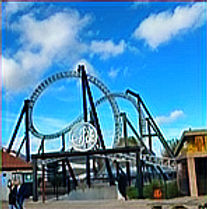
The following year another Vekoma rollercoaster opened, ‘Kumali’; a suspended looping coaster which takes its name from the alpha male lion at Flamingo Land which, by the way, originally lived at Longleat but was relocated to Flamingo Land to start a pride of its own.
This was followed in 2009 by another coaster, ‘Mumbo Jumbo’ which, when it opened, was the steepest coaster in the world.
The newest coaster at the park is ‘Sik’, another steel coaster, that opened in July 2022. During testing a month earlier, water-filled dummies fell from the ride before it was later tested with members of park staff. As much as I love rollercoasters, not sure I would have volunteered for that one!
https://en.wikipedia.org/wiki/Flamingo_Land_Resort
Tally Stick or the Irish Bata Scoir by Karen Pratley
Here in Wales we have all heard of the ‘Welsh Not’, a wooden plaque or taken used in schools back in the early to mid 19th century to discourage children from talking in their native language and to encourage them to speak English instead, so I was very surprised to find a very similar punishment on my recent trip to Ireland!
I was lucky enough to a have a few hours to look around the pretty town of Cobh in the south of Ireland and most of its tourist attractions were based around the Titanic that stopped off there before heading to its doomed journey to USA. As I wandered around a local museum I came across the Irish equivalent to our Welsh Not! It seems that when the 1831 State Education system was introduced one of its main aims was to teach English to Irish children. The Bata Scoir or Tally stick was made of wood and hung around a child’s neck with string, and each time a child was caught speaking their native tongue instead of English a notch was carved into the Bata! At the end of the school day the notches were tallied up and the child beaten according to the number of notches accumulated that day! Imagine that in the school system today!
Dad’s Army Iceland style!
Have you ever watched the TV programme Dad’s Army about the Home Guard at Warminster-on-Sea? It’s a great comedy where the men left behind during the war make-do with whatever they can to defend and protect from any invasion that might happen in their area. Well, during my recent trip to Iceland and a visit to the Port town of Akureyri, I came across something that made me smile and think of this TV show...except this was real and not a made up story!
Akureyri is a rather isolated and, during World War II, fairly unknown place and the locals had little thoughts on arming themselves against any attacks so arms and equipment was a low priority. At the northern most camp on the Fjord they built and sandbagged gun emplacements but due to lack of actual guns they painted telegraph poles the appropriate colour and pointed them towards the sea with camouflage nets over them. They hoped that from the air they would look like real guns when German reconnaissance planes flew over.
When snow was on the ground during the winter, the men trampled footprints into the snow backwards and forth between the ‘gun’ emplacements to look as if they were manned at all times. They never found out if the Germans realised they were fake but the Icelandic planes that flew over thought they looked real!
They eventually got 90 millimetre anti aircraft guns but the planes were too high for their range and only a few rounds were ever fired for practise!
Quick Quiz
What year?
-
What year was the first lawn tennis championship at Wimbledon?
-
What year was the National Prevention of Cruelty to children founded?
-
What year did the Labour Government introduce the National Health Service?
-
July 4th of what year was American Declaration of Independence signed?
-
What year did Andy Pandy, Teddy and Looby Loo first appear on BBC television?
MUSEUM HIGHS AND WOES
There is no getting away from it. Ask any of our volunteers and they will tell you that museums are expensive to run. We have the usual expenses associated with any building – gas, electricity, broadband and so forth – but we also have the particular costs of looking after the precious objects and documents in our care. From time to time we need to use the specialist services of a conservator, for example to look after a damaged piece of textile or painting but did you know we also have to use special boxes and sleeves to store the collections? These items have to be ordered from specialist suppliers and they don't come cheap.
Why don't we just pop down the supermarket for them? Our Curator can explain in more detail but, briefly, ordinary plastic sleeves and cardboard boxes contain chemicals such as acid which would damage the items in our cares o we have to buy boxes that are low in acid or even acid free. The photo here shows one of each type, the larger one is a low acid box while the smaller one beneath is acid free and is used for delicate items such as textiles.
You might also be surprised if you saw the specialist cleaning materials we have to buy – possibly the most delicate vacuum cleaner I have ever seen along with special brushes and polishes. The list could go on.
Our large national museums must be horrendously expensive to operate but they also have the clout to stage major exhibitions and generate a lucrative income stream. One example is the Bayeux tapestry currently on display at the British Museum. Hugely popular, tickets for this exhibition are already completely sold out for the rest of 2026 despite costing £33. I am glad I had the chance to see the Bayeux Tapestry at its home museum in Caen several years ago – it is as impressive as it looks from the photographs.
You will not be surprised to hear that in the current difficult economic climate, museum magazines and journals regularly carry reports of museums closing, being mothballed, or having funding and staffing cuts. But, there are glimmers of hope. Just last month I reported on the new museum being built to complement the SS Great Britain at Bristol and a very interesting new museum has just opened near London.
Read on! The museum is at Trent Park north of London and is intriguingly called Trent Park House of Secrets. This stately home started life in the 1780s, was rebuilt in the 1890s and then refurbished in the 1920s to provide a luxurious and glamorous weekend retreat for its millionaire owner. However, what makes this building of such interest is that during the Second World War the house and grounds were transformed into a state of the art surveillance centre with bugging devices everywhere and staff hidden away listening in to conversations every hour of the day. Who were they listening to? No less than captured German generals! These prisoners of war were not shipped off to the usual prisoner of war camps. They were housed in great comfort at Trent Park and their privileges included being able to wander in the grounds, use an extensive German language library, take escorted trips to London and have the services of a visiting tailor to look after their uniforms. The website (see below) contains a wealth of information and makes for a fascinating read even if you aren't planning a visit. It isn't the easiest of places to get to from our part of the world but there are already coach trips to Bletcheley Park and so, who knows, if Trent Park House proves popular it might be added to the itinerary options.
Jen Price
https://trentparkhouse.org.uk/
Quiz Answers
-
1877
-
1884
-
1948
-
1776
-
1950